Boost Efficiency with Real-World HVAC Automation Examples
Boost Efficiency with Real-World HVAC Automation Examples ! HVAC engineer monitors automation dashboard at desk Running an HVAC business in 2026 means dealing with rising energy costs, demanding clients, and razor-thin margins.

Running an HVAC business in 2026 means dealing with rising energy costs, demanding clients, and razor-thin margins. Most owners know automation can help, but vague promises don't pay bills. What actually moves the needle is seeing real numbers from real buildings. This article breaks down proven HVAC automation examples with concrete savings data, so you can make smarter decisions about where to invest next and what kind of returns to expect before you commit a single dollar.
Key Takeaways
| Point | Details |
|---|---|
| Energy and cost savings | HVAC automation can reduce energy use by 15% to 28% and deliver rapid payback. |
| AI and IoT impact | Advanced controls and sensors can minimize comfort complaints and maximize efficiency. |
| Layered approach works best | Combining BMS, smart maintenance, and niche upgrades yields optimal results. |
| Monitoring is essential | Continuous performance tracking helps you sustain savings and spot issues early. |
Top criteria for evaluating HVAC automation solutions
Before jumping into specific examples, you need a clear filter for evaluating any automation tool. Not every solution fits every operation, and the wrong choice wastes time and money.
Here are the key criteria to assess before you buy:
- Energy savings potential: HVAC uses 40-60% of a building's total energy load, which means automation has enormous room to cut costs.
- Compatibility: Does the solution connect with your existing Building Automation System (BAS) or Building Management System (BMS)?
- Ease of use: Look for mobile-friendly dashboards and intuitive interfaces your team will actually use.
- ROI speed: How fast does the investment pay back? Months matter, not just years.
- Client comfort impact: Automation that reduces complaints builds loyalty and referrals.
- Integration support: Prioritize tools that work with IoT devices, AI controls, and remote diagnostics.
If you're new to this space, reviewing home automation basics can help you understand the foundational concepts before evaluating vendors.
Pro Tip: Always ask vendors for documented case studies showing measurable savings and complaint reduction. If they can't provide data, move on.
Real-world example 1: IoT sensors & AI controls for dramatic cost reduction
With core evaluation points in mind, let's look at the first automation example and its impressive results.
IoT (Internet of Things) sensors collect real-time data from across a building, including temperature, humidity, occupancy, and equipment performance. AI controls then analyze that data continuously and adjust HVAC settings to optimize efficiency, something no manual routine can match at scale.
The results from one large deployment are striking:
- Building size: 480,000 sq ft office tower
- Energy savings: 28% reduction, $392K annually
- Comfort improvement: 74% fewer comfort complaints
- Key driver: Continuous AI optimization replacing static manual schedules
The AI didn't just follow rules. It learned patterns, anticipated load changes, and recalibrated in real time. That's the difference between a thermostat and a system that thinks.
Understanding the importance of smart thermostats is a solid starting point, but full IoT and AI integration takes performance to another level. For more context on what's possible, explore energy-efficient HVAC examples that show how these systems perform across building types.
Pro Tip: Track both energy cost and comfort ticket volume from day one. Showing clients both metrics makes the ROI case undeniable.
Real-world example 2: Condition-based maintenance and predictive smart monitoring
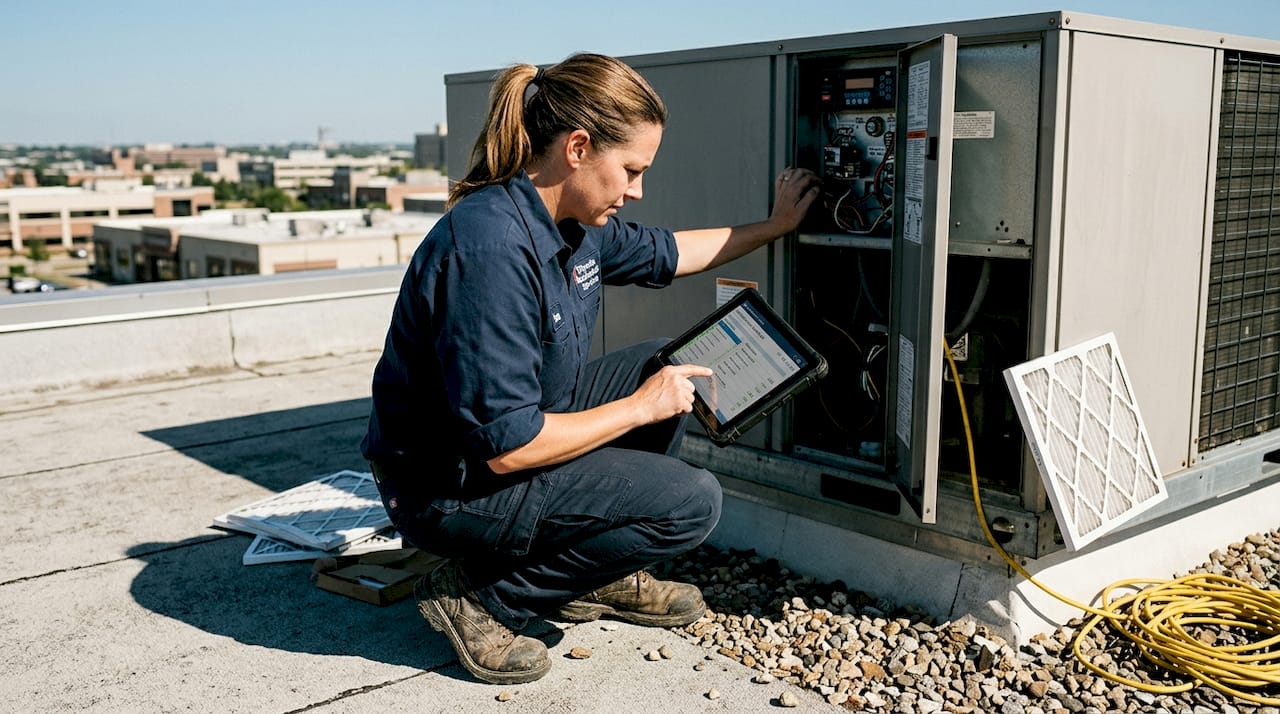
Building on intelligent controls, another automation lever is dynamic, condition-aware maintenance. Instead of servicing equipment on a fixed calendar, condition-based maintenance (CBM) triggers action based on actual equipment data, like vibration levels, temperature spikes, or pressure drops.
Here's how CBM compares to traditional scheduled maintenance:
| Metric | Scheduled maintenance | Condition-based maintenance |
|---|---|---|
| Service timing | Fixed intervals | Data-triggered |
| Emergency repairs | Frequent | Significantly reduced |
| Annual energy savings | Minimal | Up to 25% |
| Payback period | N/A | ~9 months |
Portfolio-wide smart monitoring achieved a 25% annual energy cost reduction with a 9-month payback period across a multi-building office portfolio. That's a fast return by any standard.
To implement CBM in your operation, follow these three steps:
- Install sensors on critical equipment (compressors, air handlers, chillers) to capture live performance data.
- Connect to a monitoring platform that flags abnormal readings and generates maintenance alerts automatically.
- Review and recalibrate alert thresholds quarterly based on seasonal patterns and equipment age.
For hands-on guidance, installing smart thermostats is often the first step toward a fully monitored system. Pairing that with HVAC economizer energy savings strategies compounds the financial benefit.
Real-world example 3: Building Management Systems (BMS) and integration architectures
Once you know the power of active maintenance, it pays to look at the backbone: BMS and integration strategies that scale value across an entire portfolio.
A modern BMS connects three layers: field sensors that collect data, Direct Digital Controllers (DDC) that process and act on it locally, and a management layer that gives operators a centralized view. Modern BMS platforms use BACnet and Modbus as standard open protocols, enabling different brands and devices to communicate without proprietary lock-in.
Key BMS applications include:
- Chiller sequencing: Automatically runs the most efficient chiller combination based on load
- Demand limiting: Prevents peak demand charges by shedding load intelligently
- Remote diagnostics: Flags faults before they become failures
One compelling result comes from a real estate portfolio upgrade. Trane Tracer SC optimization delivered a 15% energy reduction and $12,700 per year in savings for Johnson Development Associates.
"DDC controllers are designed to operate stand-alone if the network goes down, ensuring reliability even during connectivity failures."
For HVAC businesses managing multiple client sites, automation for home HVAC principles apply at every scale. Pair BMS with efficient thermostat control strategies to maximize savings per site.
Noteworthy niche upgrades: Economizer sequences, occupancy controls, and AI frameworks
Beyond the core systems, smaller smart upgrades and innovative AI applications can squeeze even greater value from existing equipment.
Economizer controls use outside air to cool buildings when conditions allow, reducing mechanical cooling load. But they're prone to glitches. Common issues include discharge air temperature (DAT) spikes and dew point control failures during transitions. Setting automated alerts for abnormal transition behavior catches these problems before they waste energy.
Occupancy-based controls are a high-impact, often overlooked upgrade. In one mall retrofit, occupancy-based controls and DCV saved 1,276 MMBTU in cooling energy and 1,616 MMBTU in reheat annually. DCV stands for Demand Control Ventilation, which adjusts fresh air delivery based on actual occupancy rather than peak assumptions.
AI frameworks are now being tested at the field level with measurable results. AI optimization frameworks achieved 7.66% energy savings even under hardware-in-the-loop testing conditions, which simulates real-world constraints.
"Economizer enablement is one of the highest-payoff moves in HVAC controls, but only when monitoring catches the instability that often follows activation."
Explore economizer automation benefits and pair them with energy-efficient upgrades for a layered efficiency strategy.
Hard truths and overlooked lessons about HVAC automation
Here's what most guides won't tell you: the technology is rarely the problem. The failure point is almost always the process around it.
Businesses that chase the newest sensor or AI platform without defining success metrics end up with expensive hardware that collects dust. The most successful HVAC operators we've seen treat automation like a living system. They test, audit, and recalibrate after installation, not just during it.
The uncomfortable truth is that staff training and ongoing system tuning matter as much as the hardware itself. A $50,000 BMS running on stale parameters delivers worse results than a $10,000 system that gets reviewed monthly. Automation amplifies your process. If the process is weak, the automation just fails faster.
Ready to leverage automation for your HVAC business?
If these results inspire you, taking the right next step can ramp up your business performance significantly. At Sharon Jerman, we help HVAC business owners integrate AI-driven automation, smart controls, and digital strategies that deliver real, measurable results. Whether you need help mapping out a BMS upgrade, setting up predictive monitoring, or building a full automation roadmap, we offer tailored strategy sessions designed specifically for home service businesses. Schedule a discovery call today and find out exactly where automation can move the needle for your operation.
Frequently asked questions
What is the quickest ROI upgrade in HVAC automation?
Smart monitoring pays back in as little as 9 months based on portfolio-level field studies, making condition-based maintenance the fastest return on investment.
How much can AI-driven controls reduce HVAC energy costs?
Depending on integration depth, AI can deliver 28% annual savings in large deployments, while field-tested AI frameworks show a floor of around 7.66% even in constrained environments.
What protocols are standard for HVAC automation systems?
BACnet and Modbus are the dominant open communication protocols used across BMS platforms and automation integrations industry-wide.
Can automation improve both comfort and energy savings?
Absolutely. Real deployments show 74% fewer comfort complaints alongside significant energy cost reductions, proving that efficiency and occupant satisfaction are not trade-offs.