How Automation Drives Business Growth for Home Services
How Automation Drives Business Growth for Home Services ! Manager reviews automation dashboard in office Businesses that automate their operations can cut operational time by 50% while boosting profit margins by 10 to 15 percent.

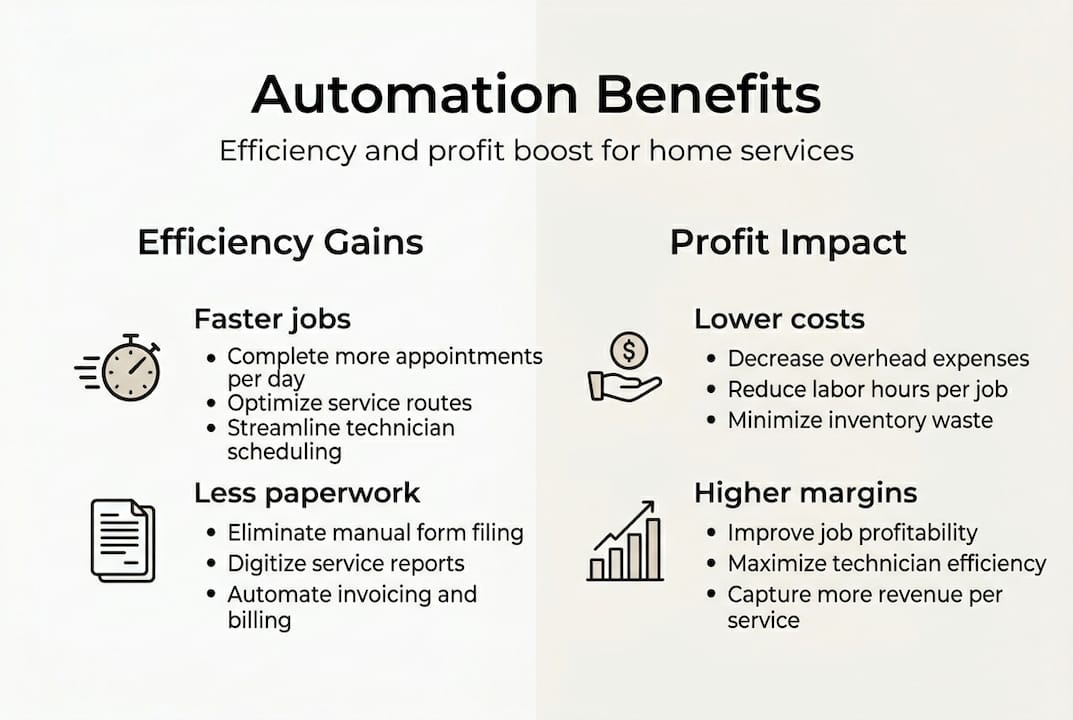
Businesses that automate their operations can cut operational time by 50% while boosting profit margins by 10 to 15 percent. That's not a tech company statistic. That's the reality for HVAC companies, landscaping crews, and construction firms that stopped doing everything by hand. If you've assumed automation is only for companies with massive budgets and full IT departments, this article will change your thinking. Here's exactly what automation means for your business, what the numbers show, and how to start applying it practically.
Key Takeaways
| Point | Details |
|---|---|
| Automation boosts efficiency | Home service businesses can save up to 50% in operational time with automation. |
| Profit margins increase | Automation delivers 10–15% higher profit margins and reduces failure rates. |
| Small teams gain big advantages | Automation allows even small businesses to compete effectively and respond quickly. |
| Implementation requires good planning | Careful tool selection and team buy-in are key to successful automation adoption. |
Understanding automation in home services
Automation in home services is not about robots replacing your technicians. It's about software and connected devices handling repetitive, time-consuming tasks so your team can focus on skilled work that actually grows your business.
In practical terms, automation includes a wide range of tools and processes:
- Automated scheduling software that books, confirms, and sends reminders for service appointments without phone tag
- Automated billing and invoicing that generates and sends invoices the moment a job closes
- Predictive maintenance alerts through IoT (Internet of Things) sensors that monitor equipment and flag issues before they become costly breakdowns
- Automated quote generation that pulls from a standardized price list and delivers professional estimates in minutes
- CRM (Customer Relationship Management) automation that follows up with leads, tracks customer history, and triggers review requests after completed jobs
- Payroll and time-tracking automation that logs hours and calculates pay without manual data entry
The Internet of Things plays a particularly important role here. Smart sensors installed in HVAC systems, irrigation networks, or construction sites can feed real-time data to a central dashboard. For example, home lighting automation already shows how connected devices can reduce manual oversight while improving energy efficiency. The same principle applies across every home service vertical.
"Automation is no longer a luxury feature for enterprise businesses. For home service companies ready to scale, it's the single most impactful operational change available."
The automation advantage research confirms this. Across service-based businesses, automation consistently delivers measurable returns in time savings, margin improvement, and reduced business failure rates. The key is understanding which tasks to automate first and which tools fit your specific workflows.
The measurable impact of automation on efficiency and profits
With proven tools in place, the numbers tell a compelling story. Research from a PLS-SEM study on automation (a statistical modeling method used to measure cause and effect relationships) found that automation carries a path coefficient of 0.45 on operational efficiency, while IoT integration adds a coefficient of 0.38. When combined, they produce a synergistic effect of 0.29 across industries, meaning the two technologies together drive more improvement than either one alone.
Here's what that translates to in real business outcomes:
| Metric | Before automation | After automation |
|---|---|---|
| Operational time per task | Baseline | Reduced by up to 50% |
| Profit margin | Baseline | Increased 10 to 15% |
| Business failure rate | 24% | 15% |
| Businesses reporting revenue growth | Baseline | 66% |
Those aren't marginal gains. A 50% reduction in time spent on scheduling, invoicing, and dispatch means your team is doing twice the productive work in the same hours. A 10 to 15% margin improvement on a $1 million revenue business adds $100,000 to $150,000 per year directly to your bottom line.
The streamlining HVAC workflow data reinforces this. HVAC companies that standardize and automate their dispatch and follow-up workflows consistently outperform those that rely on manual coordination, particularly during peak demand seasons when every missed call is a lost job.
Pro Tip: Before rolling out any automation tool, document your current process metrics. Track how long scheduling takes, how many invoices are sent late, and how often leads go cold without follow-up. Those baseline numbers will show you exactly how much your automation investment is paying off within 90 days.
The failure rate drop from 24% to 15% is arguably the most underreported benefit. Automation removes the human error layer from critical processes like payment collection, appointment confirmations, and compliance documentation. That alone can be the difference between a business that survives a slow quarter and one that doesn't.
Automation in action: Real-world scenarios and solutions
The statistics above are powerful, but let's make this concrete. Here's how automation plays out across three common home service business types.
HVAC company: A mid-sized HVAC company serving 400 active customers used to manage scheduling through phone calls and a shared spreadsheet. Missed appointments averaged 12 per month. After switching to automated scheduling with SMS confirmation and 24-hour reminders, missed appointments dropped to under two per month. The dispatcher's time freed up entirely for upselling maintenance agreements.
Landscaping business: A landscaping crew of eight used to spend two hours per job writing up quotes by hand and another hour creating invoices. Automated quoting software cut that to under 15 minutes per job. Client onboarding that previously took three touchpoints now happens in one automated sequence, from quote approval to deposit collection to scheduled start date.
Construction firm: A small construction company integrated IoT sensors on job sites to track material deliveries, equipment usage, and project milestone completion. The synergistic effect of IoT allowed the project manager to identify supply delays three days earlier than before, preventing a $22,000 scheduling overrun. Similarly, pool automation shows how IoT monitoring can cut maintenance costs by up to 70%, and the same logic applies to site monitoring in construction and property management.
| Workflow type | Manual process outcome | Automated process outcome |
|---|---|---|
| Appointment scheduling | 12+ missed appointments/month | Under 2 missed/month |
| Quote and invoice creation | 3 hours per job | Under 15 minutes |
| Project monitoring | Reactive response to delays | Proactive alerts 3 days early |
| Lead follow-up | 40% contacted within 48 hours | 100% contacted within 1 hour |
For property management automation, the benefits are similarly clear: less manual oversight, fewer security lapses, and faster response to maintenance issues.
Steps to automate a simple operational process:
- Identify the task causing the most friction or delay in your current workflow
- Map out every manual step involved in completing that task from start to finish
- Research software tools specifically built for your industry (look for HVAC, landscaping, or construction-specific platforms)
- Choose a tool with a free trial or pilot option before committing
- Assign one team member to own the setup and testing process
- Run the automated process parallel to your manual one for two weeks
- Measure outcomes, adjust settings, and then replace the manual process entirely
Key factors and common challenges when implementing automation
Knowing automation works is one thing. Successfully implementing it is another. The businesses that see the biggest gains follow a clear set of practices, while those that struggle often trip on predictable obstacles.
What drives successful automation adoption:
- Clear goal setting: Know what problem you're solving before selecting a tool. Faster invoicing, fewer missed calls, and better lead follow-up are all valid goals, but each requires a different solution.
- Staff buy-in from day one: Your team will resist any change that feels like a threat to their role. Frame automation as a tool that eliminates their least favorite tasks, not their jobs.
- Choosing the right tools: Industry-specific platforms outperform generic ones. A scheduling tool built for landscaping will handle seasonal capacity, recurring jobs, and route optimization in ways a generic calendar app never will.
- Integration planning: Your new tool needs to talk to your existing systems. Check for API connections (meaning software integrations) with your accounting software, CRM, and communication platforms before purchasing.
- Ongoing training and support: One training session is not enough. Build short, recurring check-ins into your workflow to make sure the team is using the tool correctly and consistently.
Common challenges include upfront software costs, time spent on initial setup, and the frustration of learning curves. The research on timely maintenance ROI makes a useful parallel: the short-term cost of maintenance always costs less than the long-term cost of failure. Automation investment works the same way.
Pro Tip: Pilot your first automation with a team of two or three people on a single process for 30 days before expanding. This limits disruption, makes troubleshooting easier, and gives you real performance data to build a case for wider adoption.
The 50% time savings documented across service businesses don't happen overnight. They compound as each new automation layers on top of the last. Start with your highest-friction process and build from there.
Why small businesses are positioned to benefit most from automation
Here's the perspective that often gets buried under all the enterprise-level case studies: small home service businesses have a structural advantage when it comes to automation adoption. Large companies deal with legacy systems, department sign-offs, and change management projects that can take 18 months before a single tool goes live.
You can move in weeks. A 10-person HVAC company can test a new scheduling tool, decide it works, and roll it out company-wide before a larger competitor has finished their procurement paperwork. That agility is a real competitive edge.
Small teams also feel the ROI faster and more directly. When one person's manual scheduling workload gets cut in half, the whole business notices. There's no bureaucracy diluting the result. The shift from manual to automated processes doesn't just improve efficiency metrics. It transforms how customers experience your business, faster responses, consistent follow-up, and professional communications that build trust at every touchpoint.
Unlock your business potential with expert automation solutions
If the strategies in this article resonate with where you want to take your business, working with a specialist makes the transition faster and more reliable. At Sharon Jerman's platform for home service businesses, you'll find AI strategy for home services built specifically for HVAC, landscaping, and construction companies. From custom chatbots and voice AI to content automation and Meta and Google ad management, the solutions are designed to fit the real operational challenges you face every day. Reach out to explore a tailored automation plan that matches your business size, goals, and budget.
Frequently asked questions
How much time can automation realistically save in home service businesses?
Automation can reduce operational time by up to 50% for home service businesses, making workflows significantly faster across scheduling, billing, and follow-up tasks.
Does automation work for smaller HVAC, landscaping, or construction companies?
Yes, automation delivers clear ROI for businesses of all sizes, and the path coefficient of 0.45 on efficiency holds across industries, meaning smaller teams that move quickly often see results faster than larger organizations.
What profit margin improvements can automation bring?
Businesses typically see 10 to 15% margin increases after adopting automation, alongside lower failure rates and 66% reporting measurable revenue growth.
What are the main challenges when implementing automation?
Staff resistance, integration complexity, and upfront tool costs are the most common hurdles, but businesses that pilot small and plan carefully consistently report reduced failure rates and strong long-term returns.