How to create landscaping chatbots that boost engagement
How to create landscaping chatbots that boost engagement ! Landscaping business owner using chatbot tool Landscaping businesses lose more leads than they realize simply because no one answered fast enough.

Landscaping businesses lose more leads than they realize simply because no one answered fast enough. A potential client asks about lawn care pricing at 9 PM, gets no reply, and books with a competitor by morning. AI-driven chatbots fix that problem by responding instantly, capturing lead details, and handling routine questions around the clock. This guide walks you through every step, from planning and setup to avoiding costly mistakes, so you can launch a chatbot that actually works for your business.
Key Takeaways
| Point | Details |
|---|---|
| Preparation is crucial | Gathering the right tools and clarifying goals simplifies chatbot setup. |
| Step-by-step creation | Structured steps make building and deploying your chatbot straightforward. |
| Ethics and oversight matter | Balancing automation with human support and clear policies protects your business. |
| Continuous improvement | Regularly monitoring and refining your chatbot ensures lasting benefits. |
What you need before building a landscaping chatbot
Before you touch any software, you need clarity on what you want the chatbot to do. Jumping straight into setup without defined goals is the fastest way to build something that confuses customers instead of helping them.
Start by listing your primary business objectives. Common goals for landscaping companies include:
- Capturing leads from website visitors who browse outside business hours
- Answering FAQs about services, pricing, and seasonal availability
- Booking consultations or scheduling estimates automatically
- Filtering inquiries so your team focuses only on serious prospects
Next, gather the tools and content you will need:
| Resource | What it's used for |
|---|---|
| AI chatbot platform | The software that powers the bot |
| Website or social page | Where the chatbot lives |
| Sample customer questions | Training the bot's responses |
| Internal FAQ document | Building the bot's knowledge base |
| Privacy policy | Disclosing how data is stored |
Team readiness matters just as much as the right tools. AI chatbots free up your team for more valuable and billable work, but they require oversight and ongoing training to stay effective. Plan a short onboarding session so your staff understands how to monitor conversations and step in when needed.
Data privacy is non-negotiable. When your chatbot collects names, emails, and phone numbers, you are responsible for storing that data securely. Review your local regulations and update your privacy policy before going live. Solid preparation here also makes landscaping workflow tips easier to apply once the bot is running.
Pro Tip: Pull your last 30 customer emails or inquiry forms and highlight the five questions that appear most often. Those become the foundation of your chatbot's first responses.
Step-by-step: Create and configure your chatbot
With your goals and resources ready, the actual build is more straightforward than most landscaping owners expect.
- Choose a chatbot platform designed for service businesses. Look for built-in scheduling, lead capture forms, and easy website integration.
- Connect the chatbot to your website contact page or social media messaging so it appears wherever clients reach out.
- Write response scripts using your real customer questions. Personalized, specific answers outperform generic templates every time.
- Set up lead capture workflows that collect a visitor's name, service interest, and contact information before ending the conversation.
- Build an automated scheduling flow that lets prospects book a free estimate directly inside the chat window.
- Add a live agent handoff option so the bot escalates complex conversations to a real team member.
- Test the chatbot thoroughly before launch. Run through every question path yourself and ask a colleague to try breaking it.
Here is a quick comparison of what a manual process looks like versus a chatbot workflow:
| Task | Manual process | Chatbot workflow |
|---|---|---|
| After-hours inquiry | No response until morning | Instant reply, lead captured |
| Estimate requests | Staff time required | Automated scheduling link |
| FAQ answers | Back-and-forth emails | Instant, consistent responses |
| Lead follow-up | Often delayed | Automated, immediate |
Chatbot setup requires human involvement at every stage. The AI does the heavy lifting, but your team's knowledge shapes the quality of every conversation. Applying efficient workflow techniques alongside your chatbot ensures nothing falls through the cracks.

Pro Tip: Record a short screen-share video of the chatbot in action and share it with your staff during training. Seeing the workflow removes confusion faster than any written guide.
Avoiding common mistakes and ethical pitfalls
Even well-built chatbots fail when business owners skip the guardrails. The most common mistake is treating the bot as a replacement for human judgment rather than a tool that supports it.
Here are the key pitfalls to avoid:
- Over-relying on automation for sensitive situations like complaints, pricing disputes, or complex project scopes. Those need a real person.
- Using vague or generic responses that could apply to any business. Clients notice when a reply sounds copied from a template.
- Failing to disclose that the customer is talking to a bot. Transparency builds trust. A simple line like "Hi, I'm your automated assistant" sets the right expectation.
- Ignoring customer perception and AI in your market. Some clients may be skeptical, and a clunky bot can damage your reputation faster than no bot at all.
"Ethical concerns like design theft and unrealistic client expectations must be considered when deploying AI tools in landscaping."
If your chatbot offers design suggestions or visual inspiration, be careful about copyright. Using images or concepts without permission opens you up to legal trouble. Keep all automated recommendations tied to original content your business owns.
Data protection is equally important. Use a platform that encrypts customer data and clearly states how long information is stored. A single data breach can undo years of trust with your clients.
Measuring results and improving your chatbot over time
Launching the chatbot is not the finish line. Consistent measurement is what turns a decent tool into a genuine revenue driver.
Focus on these metrics from day one:
- Lead volume: How many conversations convert to a named contact with an email or phone number?
- Conversion rate: Of those leads, how many become paying clients?
- Response satisfaction: Are customers rating the chatbot's replies as helpful?
- Escalation rate: How often does the bot hand off to a human? A very high rate signals missing content in the knowledge base.
📊 Stat to know: Businesses see measurable ROI when AI chatbots are actively monitored and improved using real usage data rather than left on autopilot.
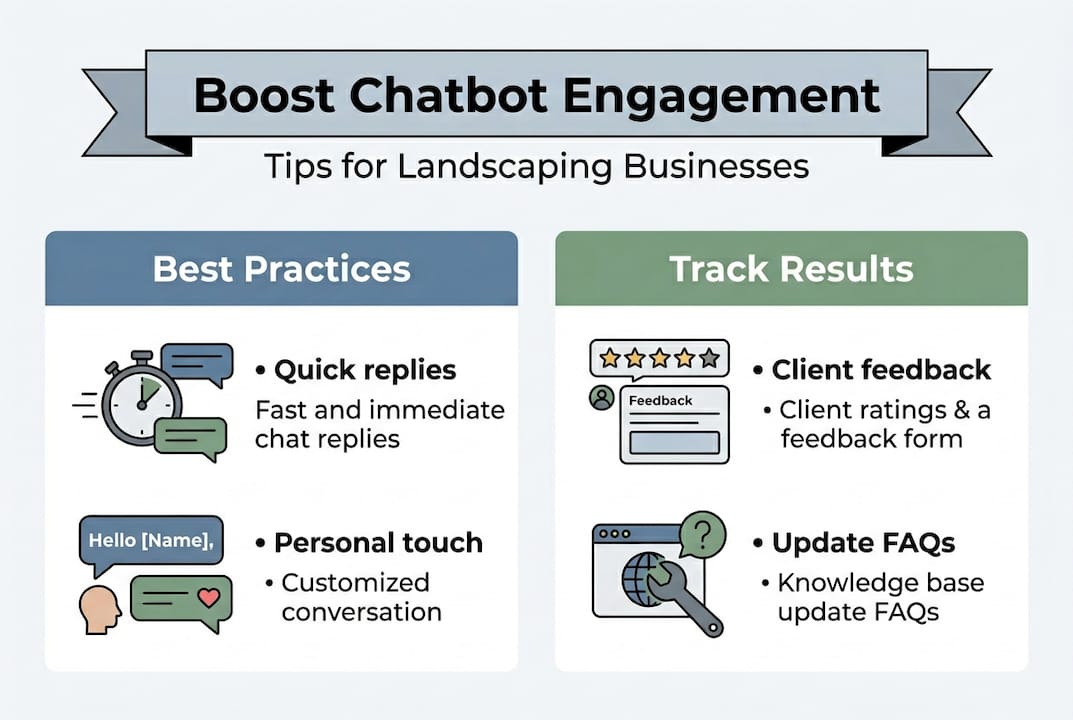
Gather direct feedback by asking clients a single question at the end of each chatbot conversation: "Did you find what you needed today?" That simple yes or no creates a fast feedback loop.
Schedule quarterly reviews where you pull conversation logs, update outdated service information, and add new FAQs based on what clients are actually asking. Keeping the knowledge base fresh also helps with property value improvement conversations where seasonal services change throughout the year.
Regular updates keep your chatbot relevant and your clients confident that your business stays on top of things.
The real secret to successful landscaping chatbots
Here is what most guides skip: the landscaping companies getting the best results from chatbots are not the ones with the most sophisticated software. They are the ones who treat the chatbot like a new employee rather than a vending machine.
A vending machine gets stocked once and left alone. An employee gets feedback, learns from mistakes, and improves over time. When you commit to monthly check-ins on chatbot performance, update responses based on real conversations, and train your team to collaborate with the tool, the results compound.
Chatbots should strengthen client relationships, not replace the personal touch that makes your landscaping business memorable. The technology handles the routine work so you can focus on the conversations that actually close deals.
Ready to transform your landscaping business with AI?
If reading this guide made you realize your business is leaving leads and revenue on the table, you are not alone. Most landscaping companies are still one step behind on automation. Getting expert support shortens the learning curve and avoids expensive trial and error.
Sharon Jerman specializes in custom AI chatbot builds, voice AI, and full digital strategy for home service businesses just like yours. From setup to optimization, the support is tailored to your real business goals. Reach out today and start converting more inquiries into booked jobs.
Frequently asked questions
What are the basic steps to create a landscaping chatbot?
Start by identifying your goals, choose a reliable chatbot platform, set up responses for typical questions, integrate it with your website, and test thoroughly before launch. Chatbot setup requires human involvement and clear project goals to work well.
How can a chatbot benefit my landscaping business?
A chatbot automates common inquiries, frees your team for higher-value work, improves response times, and enhances client satisfaction. AI frees up time for high-value work and measurably boosts efficiency.
Are there any risks to using AI chatbots in landscaping?
Risks include design originality issues, unrealistic customer expectations, and data privacy responsibilities, all of which can be managed through thoughtful implementation. Ethical concerns like design theft and unrealistic expectations should be managed proactively.
How can I keep my chatbot up to date?
Review customer interactions quarterly and update responses as services or common inquiries change. Monitoring and updating chatbots are key to maintaining continuous ROI over time.