Why AI content creation wins in home service marketing
Why AI content creation wins in home service marketing ! Home service owner edits content at kitchen table Most home service business owners assume AI content creation means churning out bland, copy-paste blog posts that nobody reads.

Most home service business owners assume AI content creation means churning out bland, copy-paste blog posts that nobody reads. That assumption is costing you real customers. The truth is, AI used strategically can produce more targeted, consistent, and SEO-ready content than most small marketing budgets allow. The catch? AI alone will risk generic output without human guidance shaping it. This guide breaks down exactly how home service businesses can use AI content creation to grow their online presence, avoid the common traps, and build a marketing engine that actually converts.
Table of Contents
- How AI content creation transforms home service marketing
- The essential human role: Preventing generic and inaccurate AI content
- AI vs. human content creation: What works best for your business?
- Maximizing impact: Practical steps to blend AI with human marketing expertise
- Our perspective: The surprising truth about AI content for home services
- How to get started with AI content creation for your business
- Frequently asked questions
Key Takeaways
| Point | Details |
|---|---|
| AI boosts efficiency | AI content tools save time and help you consistently reach more customers. |
| Human oversight required | AI content needs human editing for accuracy, emotion, and brand alignment. |
| Best results blend AI and human | Using AI for drafts and humans for strategy delivers top-performing content. |
| Avoid generic output | Personalize and fact-check AI content to stand out and build trust. |
How AI content creation transforms home service marketing
Let's get one thing straight: AI is not here to replace your voice. It's here to amplify it. For home service businesses, where margins are tight and time is scarce, AI content tools offer something genuinely valuable: speed, scale, and consistency.
Consider what it costs to produce content manually. A single blog post can take three to five hours when you factor in research, writing, editing, and formatting. AI tools can produce a solid draft in minutes. That time savings compounds fast when you're running seasonal promotions, updating service pages, or managing a local SEO strategy across multiple neighborhoods.
AI enables scalability and rapid SEO content deployment, which matters enormously in competitive local markets where your rivals are already posting weekly. If you're only publishing once a month, you're invisible.
Here's what AI content creation actually delivers for home service businesses:
- Faster production of service pages, blog posts, and email sequences
- Keyword-optimized drafts aligned to what local customers search for
- Consistent brand messaging across platforms without burning out your team
- LLM-ready content structured to appear in AI-generated search answers
- Lower cost per piece compared to hiring freelance writers for every update
| Content Type | Manual Time | AI-Assisted Time | Savings |
|---|---|---|---|
| Blog post (800 words) | 4 hours | 45 minutes | ~81% |
| Service page | 3 hours | 30 minutes | ~83% |
| Email campaign | 2 hours | 20 minutes | ~83% |
| FAQ section | 1.5 hours | 10 minutes | ~89% |
"The businesses winning local search aren't necessarily the ones with the biggest budgets. They're the ones publishing the most relevant, consistent content. AI makes that possible for small teams."
The real transformation is not just speed. It's the ability to stay present in your market without sacrificing your attention to the actual work of running your business.
The essential human role: Preventing generic and inaccurate AI content
AI is powerful. It is also dangerously easy to misuse. When you hand AI the wheel without any direction, you get content that sounds like it was written by someone who has never actually unclogged a drain, rewired a panel, or diagnosed a leaky roof. That kind of content does not build trust. It erodes it.
This is not a minor issue. 62% of users identify quality control as their top challenge with AI-generated content. That statistic reflects a real pattern: businesses publish AI output without reviewing it, and customers notice.
Here is where human oversight becomes non-negotiable:
- Fact-checking technical claims about codes, safety standards, and pricing
- Adding brand personality so content sounds like your business, not a template
- Catching hallucinations where AI invents statistics or misquotes regulations
- Ensuring local relevance by referencing real neighborhoods, landmarks, or seasonal conditions
- Aligning with Google's E-E-A-T standards (experience, expertise, authoritativeness, and trustworthiness)
Google's ranking systems are specifically designed to reward content that demonstrates real-world experience. A plumber who writes about what causes pipe bursts in freezing climates will outrank generic AI copy every time, because the expertise shows.
Pro Tip: Build a simple review checklist for every AI draft. Check for accuracy, local specificity, brand voice, and one genuine customer insight before publishing. This takes ten minutes and dramatically improves content quality.
The best content teams treat AI like a fast, tireless junior writer who needs direction and editing. You would not publish a new hire's first draft without reviewing it. Apply the same standard to AI output. The businesses that do this consistently build authority faster than those relying on either pure automation or pure manual effort.
AI vs. human content creation: What works best for your business?
Not every content task deserves the same approach. Knowing where to deploy AI and where to rely on human judgment is what separates efficient marketing from expensive mistakes.
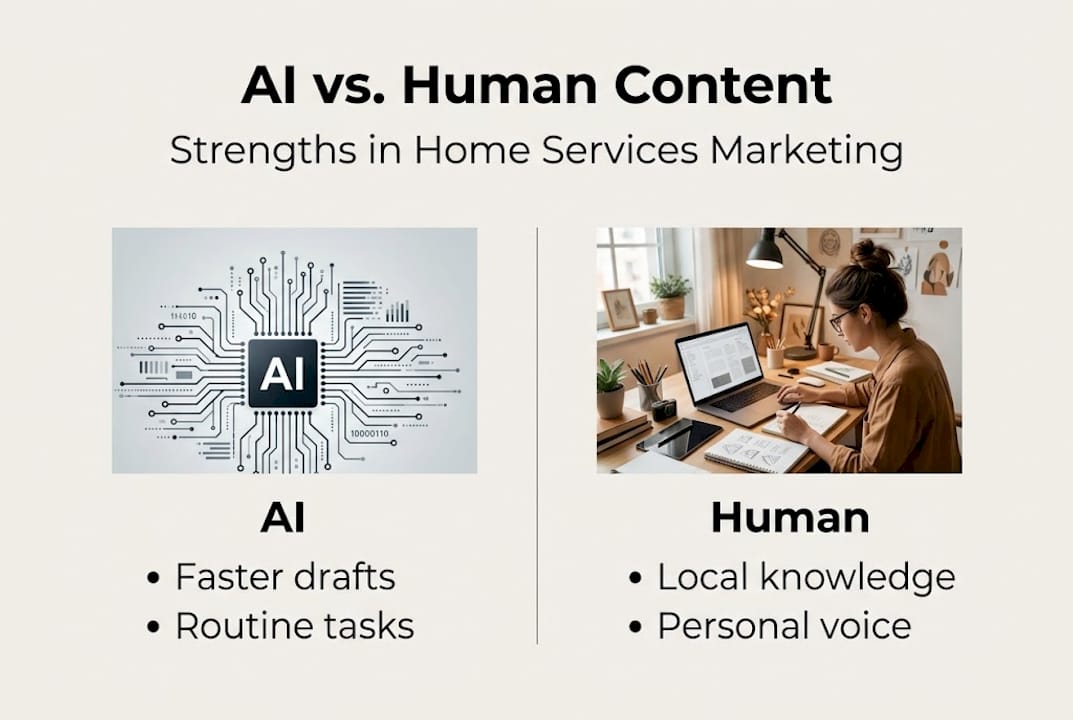
AI is genuinely excellent at high-volume, structured tasks. Humans are irreplaceable when nuance, trust, and local knowledge matter. The strategy for marketing growth that wins is one where AI handles volume and SEO speed while humans drive strategy and emotional connection.

| Task | Best Handled By | Why |
|---|---|---|
| FAQ pages | AI | Structured, repeatable, keyword-rich |
| Service descriptions | AI + Human review | Needs accuracy and brand voice |
| Customer testimonial stories | Human | Requires authenticity and empathy |
| Email sequences | AI draft, human edit | Personalization increases conversions |
| Local community posts | Human | Requires genuine local knowledge |
| Bulk blog content | AI | Speed and SEO volume |
| Crisis or complaint responses | Human | Trust and tone are critical |
Here is a practical breakdown of how to divide the work:
- AI handles first drafts for blogs, service pages, FAQs, and email templates
- AI manages scheduling and content calendar suggestions based on seasonal demand
- Humans review all drafts for accuracy, tone, and local relevance before publishing
- Humans create anchor content like case studies, before-and-after stories, and community spotlights
- Humans set the strategy including which topics to target, which audiences to reach, and how to position the brand
This division is not about distrust of AI. It is about playing to each strength. AI does not get tired. It does not forget to post on Tuesday. But it also does not know that your customers in the north side of town have older homes with specific plumbing quirks. You do. That local knowledge is your competitive edge.
Maximizing impact: Practical steps to blend AI with human marketing expertise
Knowing the theory is one thing. Putting it into practice without wasting time or money is another. Here is a workflow that home service businesses can start using immediately.
-
Define your content categories first. Split your content into routine (FAQs, service updates, seasonal tips) and specialized (customer stories, local guides, expert opinions). AI owns routine. Humans own specialized.
-
Build a prompt library. Write specific prompts for each content type. A good prompt includes your service area, target customer, tone of voice, and the goal of the piece. Vague prompts produce vague content.
-
Generate and review on a schedule. Batch your AI drafts weekly. Review them in one sitting rather than piecemeal. This keeps quality consistent and saves time.
-
Add the human layer before publishing. Every draft needs at least one real detail: a local street name, a seasonal reference, a customer scenario. Google rewards content with authentic expertise and emotion, which means generic AI copy will not rank as well as content with a genuine human fingerprint.
-
Track performance and adjust. Monitor which content drives calls, form fills, and rankings. If AI-generated service pages outperform blog posts, shift your AI budget there. Let data guide the mix.
Pro Tip: Start with your top five most-asked customer questions. Use AI to draft answers, then record yourself answering them verbally and blend that natural language into the AI draft. The result sounds human because it is.
The businesses that build this kind of structured workflow stop treating content as a chore and start treating it as a growth asset. That shift in thinking is where the real competitive advantage lives.
Our perspective: The surprising truth about AI content for home services
Here is what we see most businesses get wrong: they treat AI as an on/off switch. Either they avoid it entirely because they fear sounding robotic, or they automate everything and wonder why their leads dried up.
Complete automation produces content that feels hollow. Customers can sense when a business is not really speaking to them. That hollowness damages reputation quietly, one unread post at a time.
The winning approach is using AI as a force multiplier, not a replacement. When you pair AI's speed with your unique brand story, your local knowledge, and your real customer relationships, you get something no competitor can easily copy: content that is both efficient and genuinely yours.
AI is not a shortcut to good marketing. It is a tool that makes good marketers faster. The businesses that understand this distinction will outpace competitors who are still debating whether to try AI at all. Stop waiting for the perfect moment. Start with one content category, build the habit, and let the results guide your next move.
How to get started with AI content creation for your business
If you have been managing your marketing manually and feeling stretched thin, AI content creation is one of the highest-leverage changes you can make right now. But the biggest mistake we see is jumping in without a clear strategy, which leads to inconsistent content, wasted time, and missed opportunities.

Working with an expert in AI strategy for home services means you skip the trial-and-error phase and go straight to a system that works. From content automations and social media to custom chatbots and voice AI, the right partner helps you build a marketing engine that runs consistently without burning you out. If you are ready to turn AI into a real business advantage, let's map out your strategy together.
Frequently asked questions
Will AI-generated content hurt my Google rankings?
Not if you combine AI with human expertise, brand voice, and regular quality checks. Google rewards real expertise and originality, not AI origin alone, so the human layer is what protects and boosts your rankings.
What tasks should I automate with AI content tools?
Let AI handle routine content like FAQs, service descriptions, and email sequences while you shape brand stories and strategic direction. AI excels at volume and SEO tasks, while humans add the strategic value that converts readers into customers.
How do I keep AI content from sounding generic?
Always review and personalize AI drafts by adding real customer stories, local details, and human emotion before publishing. Human input prevents generic content and builds the brand consistency that keeps customers coming back.
Is AI content creation expensive for small businesses?
AI tools are generally affordable and save money by automating repetitive tasks, but the best results come when paired with a clear content strategy that guides what gets created and why.