Ad automation: Boost efficiency for home services
Ad automation: Boost efficiency for home services ! Home business owner reviews ad campaigns at kitchen table Running ads for your HVAC or construction business can feel like spinning plates.
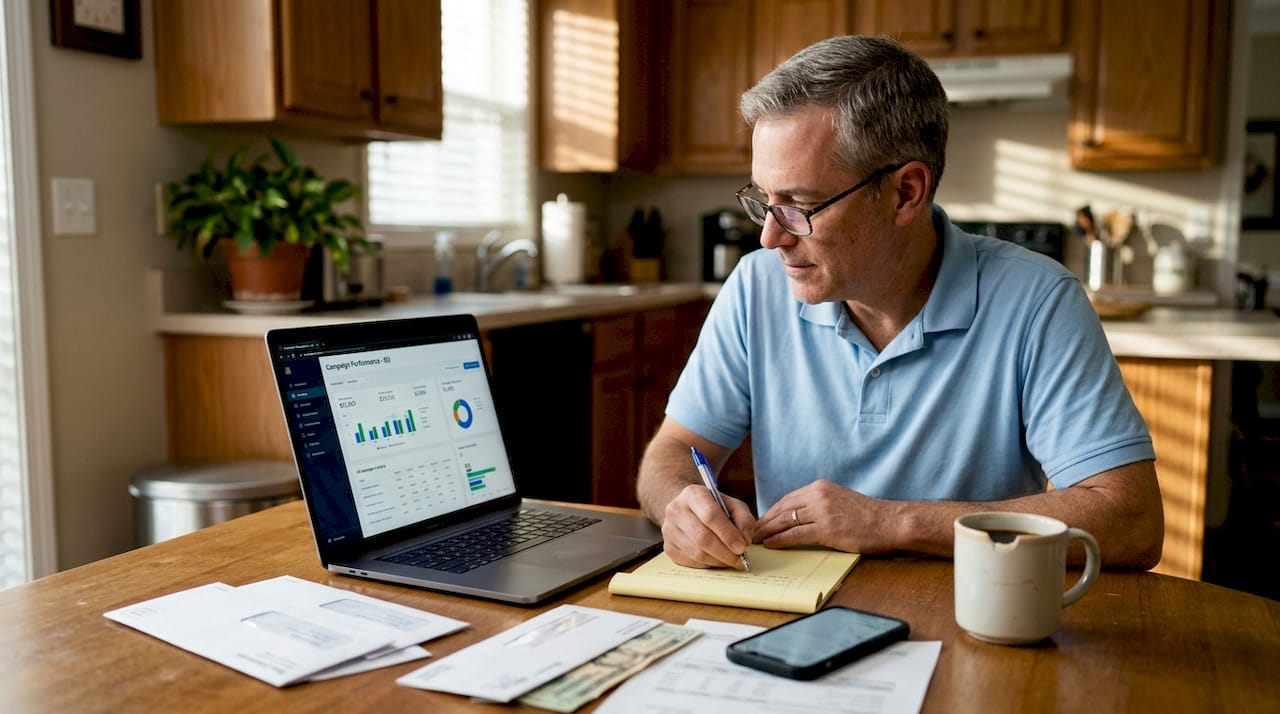
Running ads for your HVAC or construction business can feel like spinning plates. You're juggling budgets, tweaking copy, guessing which audience to target, and wondering why leads dry up without warning. Most business owners in the trades spend hours managing campaigns manually, only to get inconsistent results. Advertising automation changes that equation entirely. This guide breaks down what automation really means, how it works for home service businesses, which platforms make the most sense, and how to get started without blowing your budget or your sanity.
Key Takeaways
| Point | Details |
|---|---|
| Automation defined | Automation uses AI and algorithms to handle digital advertising tasks for you. |
| Tailored benefits | Home service businesses save time and improve targeting by adopting automation. |
| Practical adoption | Start small, choose the right platform, and monitor results for best ROI. |
| Expert input matters | Your industry knowledge makes automation most effective. |
What is advertising automation?
At its core, advertising automation is using technology to handle the repetitive, data-heavy parts of running ads so you don't have to. Think of it as a tireless assistant that monitors your campaigns around the clock, adjusts bids in real time, and shifts budget toward the ads that are actually working.
"Automation in advertising refers to the use of AI, machine learning, and algorithms to automate ad buying, bidding, creative optimization, targeting, and budget allocation" across digital platforms like Google Ads, Meta, and programmatic exchanges.
For construction and HVAC businesses, this matters because your advertising needs are specific. You're reaching local homeowners, competing against regional contractors, and often running seasonal campaigns. Manual management can't keep up with the speed of digital auctions and shifting consumer behavior.
Here's what automation typically handles:
- Ad buying: Platforms bid for placement automatically based on your goals
- Budget control: Spending shifts toward higher-performing ads in real time
- Targeting: Algorithms find the right audience based on location, behavior, and intent signals
- Creative optimization: Ad images and copy are tested and rotated to favor top performers
- Reporting: Data gets pulled and organized without manual exports
The result is a leaner, smarter ad operation that doesn't require you to live inside a dashboard. For a business owner juggling job sites and customer calls, that's not a minor perk. It's a game changer.
How automation transforms advertising for home services
Knowing the definition is one thing. Seeing how it plays out for businesses like yours is where it gets useful. Automation in advertising means smarter targeting, more efficient budget use, and faster optimization with less manual oversight.
Here's how that plays out in practice for HVAC and construction companies:
- Personalized targeting: Your ads reach homeowners searching for AC repair or roof replacement at the exact moment they're ready to hire. Automation uses behavioral signals to find those people.
- Smarter budget allocation: Instead of spreading spend evenly, the system pushes budget toward ads with better click-through and conversion rates automatically.
- Continuous creative testing: Multiple versions of your ad run simultaneously. The algorithm identifies which headline, image, or call-to-action performs best and prioritizes it.
- Reduced wasted spend: Automation pauses underperforming ads before they drain your daily budget.
- Faster response to trends: If a heat wave hits your region and HVAC searches spike, automated bidding adjusts within hours, not days.
Statistic: Businesses that use automated bidding in Google Ads can see up to 20% more conversions at a similar cost compared to manual bidding strategies, according to Google's own campaign data.
Pro Tip: If you're running seasonal HVAC promotions or contractor specials, set up automated rules to increase your daily budget during peak demand periods. You'll capture more leads without having to log in every morning to adjust manually.
A small HVAC company in a mid-size market, for example, can use Google's Smart Campaigns to target homeowners within a 30-mile radius who recently searched for "furnace repair near me." Without touching a bid manually, their ad shows up at the right time, to the right person.
Automation platforms: Comparing your options
With the benefits clear, the practical question becomes: which platform should you use? Major platforms like Google Ads and Meta each offer automation features, and third-party programmatic solutions add even more options.
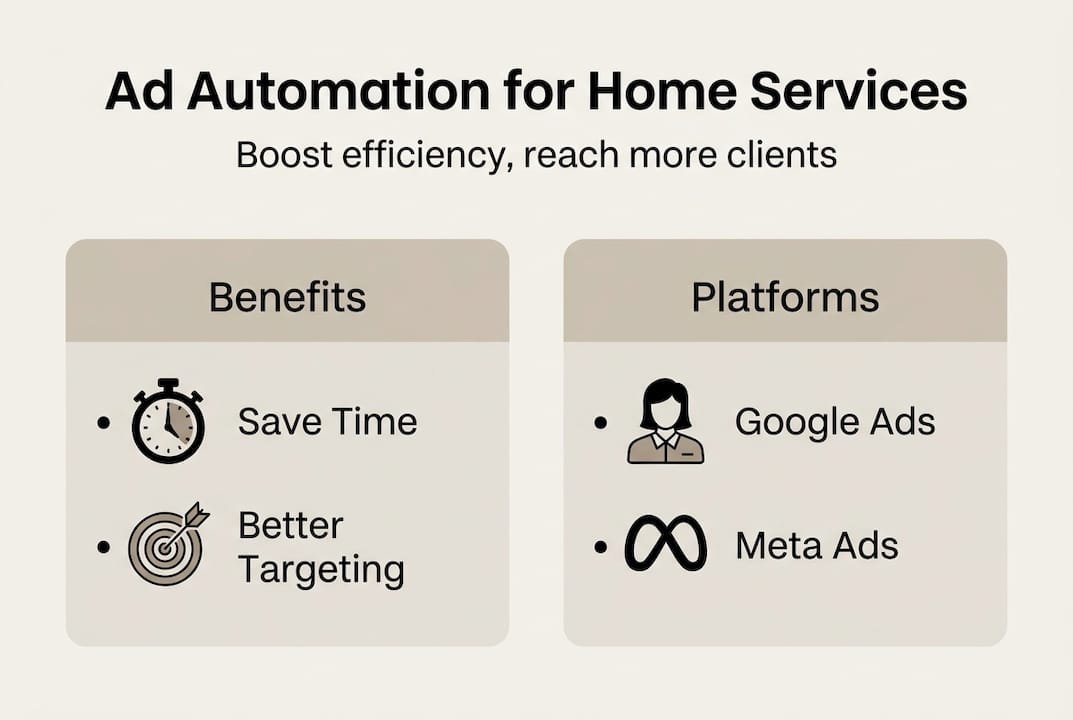
Here's a side-by-side breakdown to help you choose:
| Platform | Ease of use | Key automation features | Best for | Cost entry point |
|---|---|---|---|---|
| Google Ads | Moderate | Smart Bidding, Performance Max, Dynamic Ads | High-intent searches, local service ads | $10/day minimum |
| Meta Ads | Easy | Advantage+ targeting, automated placements | Brand awareness, retargeting homeowners | $5/day minimum |
| Programmatic (DSP) | Complex | Real-time bidding, audience segmentation | Scaling reach across multiple channels | Typically $1,000+/month |
For most HVAC and construction businesses just starting with automation, Google Ads and Meta Ads are the practical starting points. Here's how to think about it:
- Choose Google Ads if your customers are actively searching for services. Search intent is high, and Smart Bidding puts your ad in front of ready-to-hire homeowners.
- Choose Meta Ads if you want to build awareness, retarget website visitors, or promote seasonal offers visually.
- Consider programmatic only after you've established a baseline with Google or Meta and have a dedicated budget for broader reach.
Smaller businesses should resist the urge to run everything at once. Spreading thin across three platforms before you understand one is how budgets disappear without results.
Getting started: Steps for implementing automation
Most platforms now make automation accessible even for small business owners. The key is starting small and scaling what actually works.
Here's a straightforward process to follow:
- Assess your goals: Define what success looks like. Is it phone calls, form fills, or website visits? Automation needs a clear conversion goal to optimize toward.
- Set up your account: Create your Google Ads or Meta Business account, install tracking pixels or call tracking, and connect your website.
- Launch one automated campaign: Use Smart Campaigns on Google or Advantage+ on Meta. Set a conservative daily budget and let the algorithm collect data.
- Monitor results weekly: Check conversion rates, cost per lead, and which ad variations win. Don't make daily changes. Give the system 2 to 3 weeks to learn.
- Scale what works: Once a campaign shows consistent results, increase the budget incrementally and test new creative variations.
| Phase | Estimated time | Resources needed |
|---|---|---|
| Setup and tracking | 3 to 5 days | Account access, website, tracking tools |
| Initial campaign launch | 1 day | Ad copy, images, budget |
| Learning period | 2 to 3 weeks | Budget, patience |
| Review and optimization | Ongoing, weekly | 1 to 2 hours per week |
Pro Tip: Don't automate everything at once. Start with one campaign type and one platform. Learn what the data tells you before adding complexity.
The biggest pitfalls? Ignoring your analytics after setup, and automating campaigns before you've tested your creative manually. Automation amplifies what you put in, including poor messaging.
Our perspective: Why smart automation doesn't replace your expertise
Here's a truth most automation vendors won't say out loud: the tool is only as good as the person behind it. We've seen HVAC businesses run automated campaigns that generated clicks from three states away because nobody checked the geographic targeting. Automation is fast. It is not foolproof.
Your local knowledge, your understanding of what makes a homeowner in your market trust a contractor, those things cannot be programmed. Automation handles the mechanics. You bring the meaning. Keep reviewing your data, stay involved in your creative direction, and never let a campaign run on autopilot indefinitely. The businesses that win with automation are the ones that stay curious and keep testing.
Ready to boost your advertising efficiency?
If this guide gave you a clearer picture of advertising automation but you'd rather have an expert set it up right the first time, that's exactly what we help with. AI advertising solutions tailored to HVAC and construction businesses are Sharon Jerman's specialty. From Meta and Google ad automation to custom chatbots and voice AI, the goal is always the same: more leads, less guesswork, and a system that works while you're on the job site. Reach out to start a conversation about what automation could look like for your business.
Frequently asked questions
How does advertising automation actually work?
Advertising automation uses AI and algorithms to handle ad buying, bidding, targeting, and optimization across digital platforms, cutting manual effort significantly.
Can small construction or HVAC businesses afford advertising automation?
Most platforms make automation accessible for small businesses with flexible daily budgets starting as low as $5 to $10 per day.
Will automation take control away from my business?
No. You set the goals, budgets, and creative direction. Automation handles the data-heavy tasks so you spend less time inside a dashboard and more time running your business.
How quickly will I see results from advertising automation?
Automation enables faster optimization and smarter targeting almost immediately, with stronger ROI building over weeks as the platform learns your audience.